

AC Filter Cleaning After a Sandstorm in Dubai
First 24 hours
Start with the filters, not the thermostat
When a shamal blows through Dubai, the quickest way to lose cooling performance is to leave the air conditioning running on a filter that has just absorbed several weeks of dust in a single afternoon. Fine desert particulate gets in through window seals, balcony door gaps and fresh-air intakes, and the return grille pulls it straight into the indoor unit. The filter does its job and clogs. Airflow drops, the compressor runs longer to hit the same set point, and the DEWA bill climbs before anyone notices there is a problem.
Most post-storm recovery is a twenty-minute job you can do yourself: pull the filters, wash them, dry them properly, clear the outdoor unit, then watch the airflow for a day. Only a narrow set of symptoms points to something deeper, which is sand that has bypassed the filter and settled on the evaporator coil or inside the ductwork. This checklist separates the two, so you are neither paying for a duct clean you do not need nor ignoring one you do.
The post-sandstorm checklist, hour by hour
- Hour 0 to 2
Shut it down and seal up
Switch the unit off at the wall isolator and keep windows and balcony doors closed until the air outside has settled. Running the system while dust is still airborne drives the heaviest load straight onto the filter media.
- Hour 2 to 24
Wash every indoor filter
Remove and clean the filters in every indoor unit, including the ones you cleaned last week. While the front panel is open, wipe the return grille and the supply vents in the same room.
- Hour 24 to 48
Clear the outdoor condenser
Check the outdoor unit on the balcony, roof or service shaft. Brush sand out of the coil fins in the direction the fins run and make sure nothing is blocking the fan discharge.
- Day 3 to 7
Judge the airflow
Run the system as normal and pay attention to three things: how hard the air comes out of the vents, how long the rooms take to cool, and whether there is any smell in the first minute after startup. Weak airflow on a clean, dry filter means sand got past the filter.
- Week 2
Check whether the dust comes back
Wipe a shelf and leave it. If a visible film returns within two days, the system is redistributing dust rather than the room collecting it, and an inspection is worth booking.

What changes
Why one shamal undoes weeks of AC care
A filter that would comfortably last a month in normal Dubai conditions can reach the same loading in a single storm. Two things make the UAE case harder than dry dust alone.
- Storm particulate is finer than everyday dust, so more of it reaches the filter face and packs into the mesh instead of dropping out of the air first.
- Coastal humidity meets that dust on the filter and turns it into a sticky film, which restricts airflow far more than the same weight of dry sand.
- Once the mesh is saturated, the surplus goes past it and lands on the evaporator coil, where it insulates the surface and cuts heat transfer.
- Sand is abrasive, so fan blades, bearings and the blower housing wear faster than they would in a temperate climate.
That is the whole chain, and it explains why the timing matters more than the technique. A filter washed within 48 hours costs you twenty minutes. The same dust left on a coil for a month becomes a chemical clean.
How to clean an AC filter after a sandstorm
Isolate the power
Switch off at the breaker or wall isolator, not just the remote. Wear a dust mask: the load coming off a post-storm filter is not something you want to breathe in a closed room.
Release the filters
Lift the hinged front panel on a wall-mounted split, or open the return grille on a ducted system. Most apartments have two mesh filters per indoor unit. Ducted villas usually have one larger return filter plus a grille filter in each room.
Vacuum, then rinse
Vacuum the dirty face first so you are not turning sand into mud. Then rinse from the clean side outwards under lukewarm running water with a drop of mild detergent. No hot water, no stiff brush, no scrubbing: both deform the mesh permanently.
Dry fully, then refit
Air dry in shade and out of direct sunlight until there is no moisture left at all, then slide the filter back in its original orientation and reset the filter reminder if the unit has one.
One practical note for apartments in Bur Dubai, Deira and Karama, where units often run close to continuously through the cooling season: keep a spare set of filters. That way the system is never left running empty while the first set dries, which is the single most common shortcut people take after a storm.
Do not book this yet
When duct cleaning is actually needed
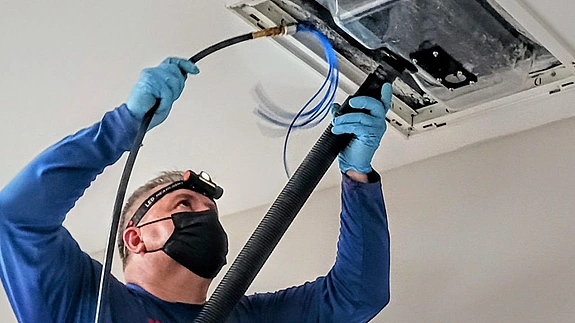
Duct cleaning is the service most often sold after a storm and most often skipped when it genuinely matters. A single dust event does not automatically dirty your ductwork. Sand stopped by a filter has been stopped. The real question is whether anything got past it, and for how long. Wash the filters first, run the system for a few days, then judge the ducts on what is left.
- Airflow at the vents is still weak after the filters have been washed and fully dried
- Grey or brown streaking on supply grilles, or grit on surfaces directly beneath them
- Dust returns to shelves and floors within a day or two of cleaning
- A musty smell in the first minute after the system starts
- The system ran right through the storm with a missing, torn or saturated filter
- Renovation work, a long vacancy or a change of tenant since the last inspection
One of these on its own is usually a coil or a drain issue. Two or more together is the point where professional AC duct cleaning earns its cost, because the contamination has moved past the parts you can reach and is being redistributed into every room the system serves.
Signs of dust buildup and poor indoor air quality
Dust that comes back too fast
Wiping a surface on Tuesday and finding a visible film by Thursday points at the AC circulating dust rather than the room collecting it. The rate of return matters more than the amount.
Weak or uneven cooling
The rooms furthest from the indoor unit stop keeping up first. Restricted airflow shows as temperature drift between rooms well before the thermostat reading looks wrong.
Symptoms indoors, relief outdoors
Morning congestion, itchy eyes or a cough that eases once you leave the flat is the classic pattern for circulating fine particulate. It deserves the fastest response in nurseries and children's bedrooms, where smaller lungs and longer hours in one room compound the exposure.
How often to clean filters and ducts in the UAE
| Task | Routine interval | Post-storm trigger |
|---|---|---|
| Wash indoor filters | Every 2 to 4 weeks in the cooling season | Within 24 to 48 hours, regardless of the last wash |
| Wipe return grille and supply vents | Monthly | Same visit as the filter wash |
| Clear the outdoor condenser | Every 3 months | Within 48 hours if sand is packed into the fins |
| Professional service: coil, drain line, refrigerant | Every 3 to 4 months through peak season | If airflow stays weak on a clean, dry filter |
| Duct inspection | Every 12 months | After any storm the system ran through with a torn or missing filter |
| Duct cleaning | Every 12 to 24 months for most homes | Only when the inspection or the signs above justify it |
Sandstorm season in the UAE runs heaviest between March and May, which lands immediately before peak cooling demand. Pulling filter checks forward through those three months is the cheapest maintenance decision available to a Dubai household. For the full picture across the rest of the year, including how apartment and villa systems diverge, see our guide on how often to service your AC in Dubai's climate.
Mistakes that make the problem worse
- Running the unit with the filter removed so it "breathes better". The dust goes onto the coil instead, where you cannot reach it.
- Refitting a filter that is still damp. In a humid flat that becomes odour and mould within days.
- Scrubbing the mesh with a stiff brush or washing it in hot water, which deforms the media permanently.
- Pressure-washing the outdoor unit. High pressure flattens the coil fins and makes heat transfer worse.
- Booking a duct clean before anyone has looked at the filters.
- Leaving the system off until the airborne dust has settled outside.
- Drying filters fully in shade before they go back in, with a spare set covering the gap.
- Rinsing gently from the clean side with lukewarm water and a mild detergent.
- Brushing loose sand off the condenser fins by hand, following the direction of the fins.
- Cleaning the filters first, then judging the ducts on the symptoms that remain a week later.
Before the next one
Keeping the dust out
You cannot stop a shamal, but you can change how much of it ends up inside the air handler. These are the measures worth having in place before March.
- Close windows and balcony doors on the dust warning, not once the sky turns
- Fit self-adhesive weatherstripping around balcony door frames and window seals
- Keep a spare clean filter set for every indoor unit
- Set the AC to recirculate rather than draw fresh air where the unit allows it
- Put coarse-fibre entry mats at every external door
- Keep shoes at the threshold in a closed cabinet
- Vacuum with a HEPA-rated machine instead of dry sweeping
- Wipe hard surfaces with damp microfibre, never a dry cloth
- Have the condenser cleaned before summer so the season starts clean
- Keep the condensate drain line clear, since dust plus moisture is what blocks it
- Bring the filter check schedule forward for March, April and May
- Book the annual duct inspection outside peak season when technicians have more time
When to call a professional
Airflow has not recovered
Clean, dry filters and the vents still feel weak. That is sand sitting on the evaporator coil, and it needs a coil clean rather than another filter wash.
New noise or vibration
Rattling, grinding or a hum that appeared after the storm usually means sand has reached the fan bearings or unbalanced the blower. Get it looked at before running the system hard.
Water where it should not be
Dust combined with condensate blocks drain lines. A damp patch on the ceiling near a ducted unit, or dripping from a wall-mounted one, should be dealt with the same week.
Smell that does not clear
A musty smell after a week of clean filters points at moisture inside the unit or the duct run. A burning or electrical smell means switching off at the isolator and calling immediately.
The dividing line is straightforward: filters, grilles and loose sand on the condenser casing are household jobs. Anything behind the coil, anything involving refrigerant, and anything electrical belongs to a certified AC repair technician working across Mitsubishi, LG, Hitachi, Daikin, Panasonic, Samsung and Haier equipment, because guessing at those parts is how a cleaning problem turns into a replacement problem.
Help
Frequently asked questions
The questions Dubai residents ask most often in the week after a dust event.
How soon after a sandstorm should I clean my AC filter?
Within 24 to 48 hours, and it does not matter when you last cleaned it. A storm can load a filter to the same degree as several weeks of normal running, so the previous schedule stops being relevant. The practical sequence is to leave the system off while dust is still airborne, then wash the filters once the air outside has settled.
Can I clean the filter myself or do I need a technician?
Washable mesh filters in wall-mounted split units are a household job. Isolate the power, lift the panel, vacuum the dirty side, rinse from the clean side under lukewarm water, and dry fully in shade before refitting. Pleated and HEPA cartridge filters are replaced rather than washed. If the filter sits behind a ceiling access panel you cannot reach safely, that is the point to call someone.
Do I need duct cleaning after every sandstorm?
No. Treat a storm as a reason to inspect, not an automatic reason to clean. Most residential duct systems in the UAE are cleaned every 12 to 24 months. Book earlier only if airflow stays weak on clean filters, if dust returns to surfaces within a day or two, if there is streaking on the supply grilles, or if the system ran through the storm with a torn or missing filter.
My AC is still weak after I cleaned the filter. What now?
That normally means fine sand went past the filter and settled on the evaporator coil, where it acts as insulation and cuts heat transfer. A coil clean restores it. Check two other things first: that the filter is fully dry and correctly seated, and that the outdoor condenser is not packed with sand or obstructed on the discharge side.
How often should AC filters be cleaned in the UAE generally?
Every 2 to 4 weeks through the active cooling months, which is considerably more often than the manufacturer intervals written for temperate climates. Bring that forward during March to May, when sandstorm activity peaks. Homes with pets, ground-floor apartments near open sand, and properties close to construction work sit at the shorter end of the range.
Should I turn the AC off during a sandstorm?
Switching it off, or at minimum setting it to recirculate rather than drawing fresh air, is sensible while dust is actively blowing. In Dubai's summer heat, going without cooling for hours is not always realistic, so the workable compromise is to keep every window and balcony door shut, run the system, and then wash the filters as soon as the storm passes.
Does a clogged filter really increase my DEWA bill?
Yes. A restricted filter forces the system to run longer to reach the same set point, and the compressor is the largest electrical load in most homes. The effect compounds if sand also reaches the coil, because reduced heat transfer extends run times further. Cleaning the filter is the lowest-effort efficiency measure available after a storm.
Not sure if it is the filter, the coil or the ducts?
If airflow has not come back after a proper filter clean, a technician can check the coil, the drain line and the ductwork in one visit and tell you which of the three is actually causing it. Awal Experts works across Dubai seven days a week, and a consultation costs nothing.